
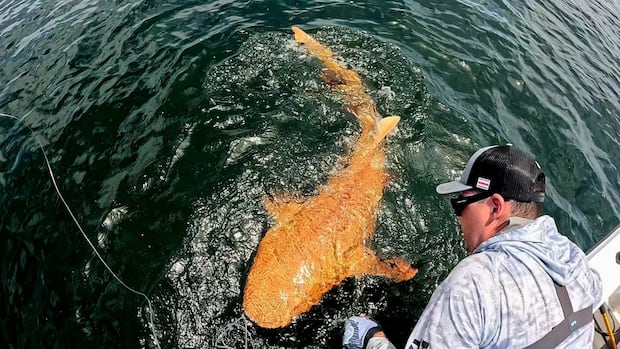
As It HappensBright orange shark shocks and delights scientist
Marine biologist Daniel Arauz Naranjo has spent a lot of time with a lot of sharks. But he’s never seen one the same colour as a Creamsicle before.
So when he was shown footage and photographs of a bright orange nurse shark in the shallow waters off Costa Rica, he was beside himself.
“As soon as I saw it, I was like, what? That is crazy,” Naranjo, executive director of Costa Rica’s Rescue Center for Endangered Marine Species, told As It Happens host Nil Köksal. “Wow. It’s just amazing.”
Naranjo has since co-authored a paper that suggests a rare combination of genetic mutations is behind the shark’s unusual colouring. The findings were published last month in the journal Marine Biodiversity
Now he and his colleagues are wondering whether the creature is a one-of-a-kind, or if there are more candy-coated carnivores cavorting off the Caribbean coast.
Reeling it in, and letting it go
Despite his fascination with the orange shark, Naranjo hasn’t seen it in person.
The pictures and footage come from a crew of sports fishers off Costa Rica, who reeled in the mysterious fish in August of last year.
“We saw an orange glow below the water and I said, ‘My God, what is this?'” Garvin Watson, owner of the Parismina Domus Dei hotel in Barra del Parismina, told the New York Times. “We were all screaming like crazy.”
The fishermen, who practice catch-and-release, documented their discovery before setting the shark free, then shared the findings with local scientists.
Naranjo says they did everything right.
“We have a very good relationship with the sports fishermen here in Costa Rica,” he said. “They are very trained in how to handle these animals, take a picture, and just let it go without too much stress. So that’s the type of fishing that we like.”

Nurse sharks, which are usually somewhere between tan and dark brown in colour, are a vulnerable species, according to the International Union for Conservation of Nature. Their populations are on the decline thanks to climate change, pollution, habitat destruction and overfishing.
The nocturnal creatures dwell in warm, shallow waters, where they spend their evenings scouring the sea floor for snacks like crustaceans, molluscs and stingrays. During the day, they can be found lounging in caves and crevices, according to the Florida Museum of Natural History.
They reach an average length of 2.4 metres, and are generally quite docile in their interactions with humans.
2 rare mutations at once
Naranjo and his colleagues confirmed the authenticity of the footage, then delved into the scientific literature to unravel the mystery of the shark’s orange shark.
They concluded the creature most likely has two simultaneous rare genetic conditions: albinism and xanthism.
Albinism is characterised by a lack of melanin, or skin pigment, in both the skin and eyes. It’s rare, but not unheard of in sharks.
Xanthism causes animals to appear yellow or golden in colour. It has been documented in reptiles and freshwater fish, but Naranjo says this is the first reported case in a shark.
He says the shark’s albinism is likely accentuating the yellowish hues from its xanthism, creating its bright neon orange complexion.
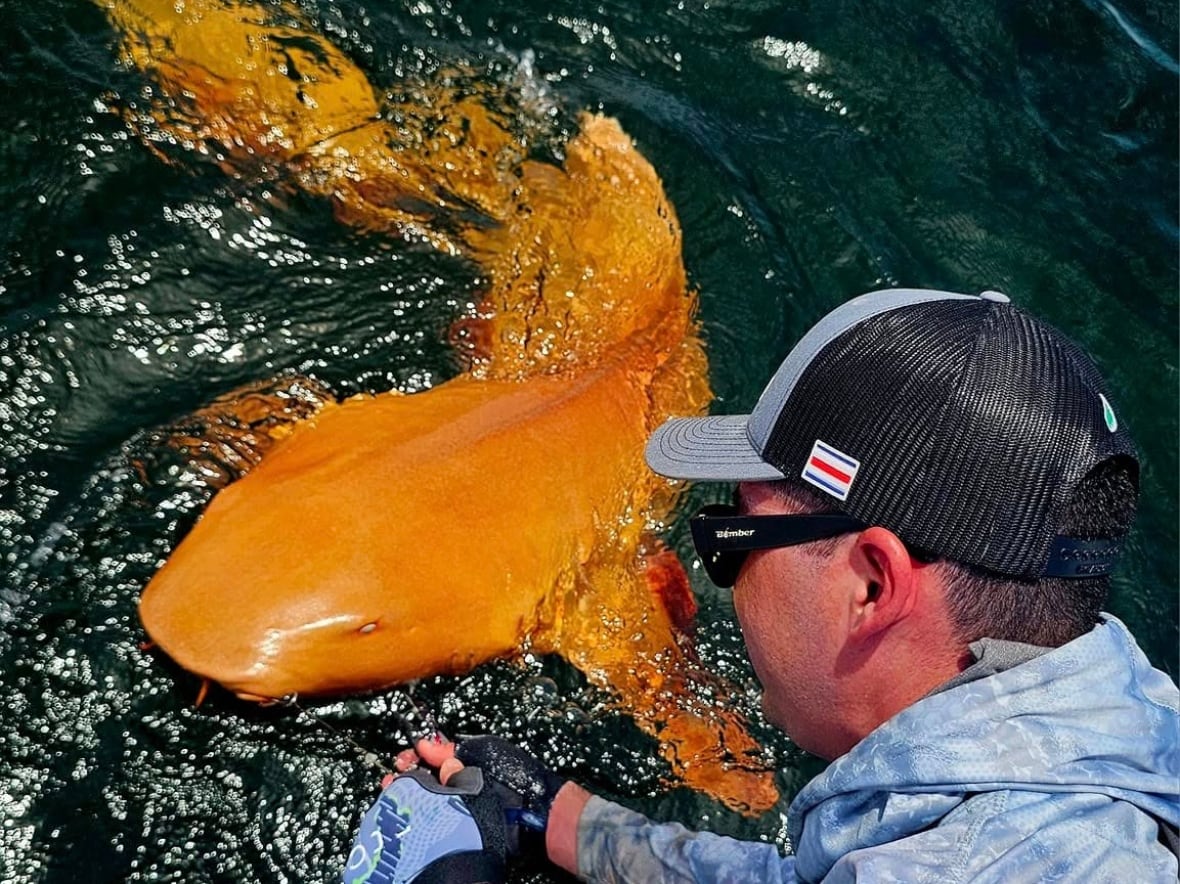
Shark scientist James Sulikowski, who was not involved in the research, says the study’s conclusions are sound, and the shark itself is fascinating.
“Anytime you find a shark, or other animal, with unique colouration, it is very interesting, especially since typical colour patterns are geared for increased species survival,” Sulikowski, director of Oregon State University’s Big Fish Lab, told CBC in an email.
“It makes you wonder how this shark, with such a unique colour pattern, was able to not only survive but thrive in their ocean environment.”
That’s something Naranjo wonders, too. He says the shark’s orange skin “could be a hindrance,” making it more visible to both its predators and its prey.
Then again, maybe not. The waters where the shark was found are extremely muddy, he says, which may help keep it hidden.
“Who knows? Nobody even noticed that there was an orange shark around, and it managed to survive and now it’s an adult,” he said. “It’s a pretty good size, and it was very energetic. So it seems like it’s doing very well.”
The big question now is whether the shark is unique, or if there are others out there like it.
According to Naranjo, genetic mutations can be completely natural. But they can also be triggered by environmental factors, like temperature changes or pollution.
“We actually don’t know why that happened,” he said.
Naranjo has remained in touch with the fishermen, who have promised to let him know if they spot another orange shark. But, ideally, he says he’d like to see one up close for himself.
“Oh man,” he said. “I would love it.”